
From Prevention to Prediction – the next step in Fire Safety
At VDL Industrial Products, we work daily with partners who prioritize innovation and safety. One of those partners is Firefly, a leader in Spark and Hot Particle Detection systems since the 1970s. These prevention systems are designed to rapidly detect and extinguish ignition sources—such as sparks and hot particles—before they can develop into a fire or dust explosion.
Over time, Firefly’s prevention solution was complemented with the Quick Suppression Systems, a protective solution engineered to safeguard machines and high-risk areas, using quick flame detectors and fast acting water mist system. The Quick Suppression System is designed to quickly detect and suppress fires, to minimize damage and reduce costly downtime.
Driven by their mission to save lives and keep our customers in production, Firefly continuously develops new products and concepts to deliver higher safety, earlier detection, and smarter ways to help customers avoid fires.
Now, Firefly is taking this one step further by introducing Firefly’s Prediction Solutions.
Predicting risks before they become ignition sources
Firefly’s prediction solutions focus on identifying the conditions that generate ignition sources, even before they develop into sparks, hot particles, flames, or explosion risks. The aim is to identify the problem and provide early insight, that will support operators to take corrective actions at an early stage.
The concept is a condition-monitoring system that enhances traditional fire safety by offering a data-driven approach. It involves real-time tracking of the state and performance of the machinery using data from sensors and analytical tools. The aim is to identify early signs of process disturbances and provide early insight that will support operators in taking corrective actions at an early stage.
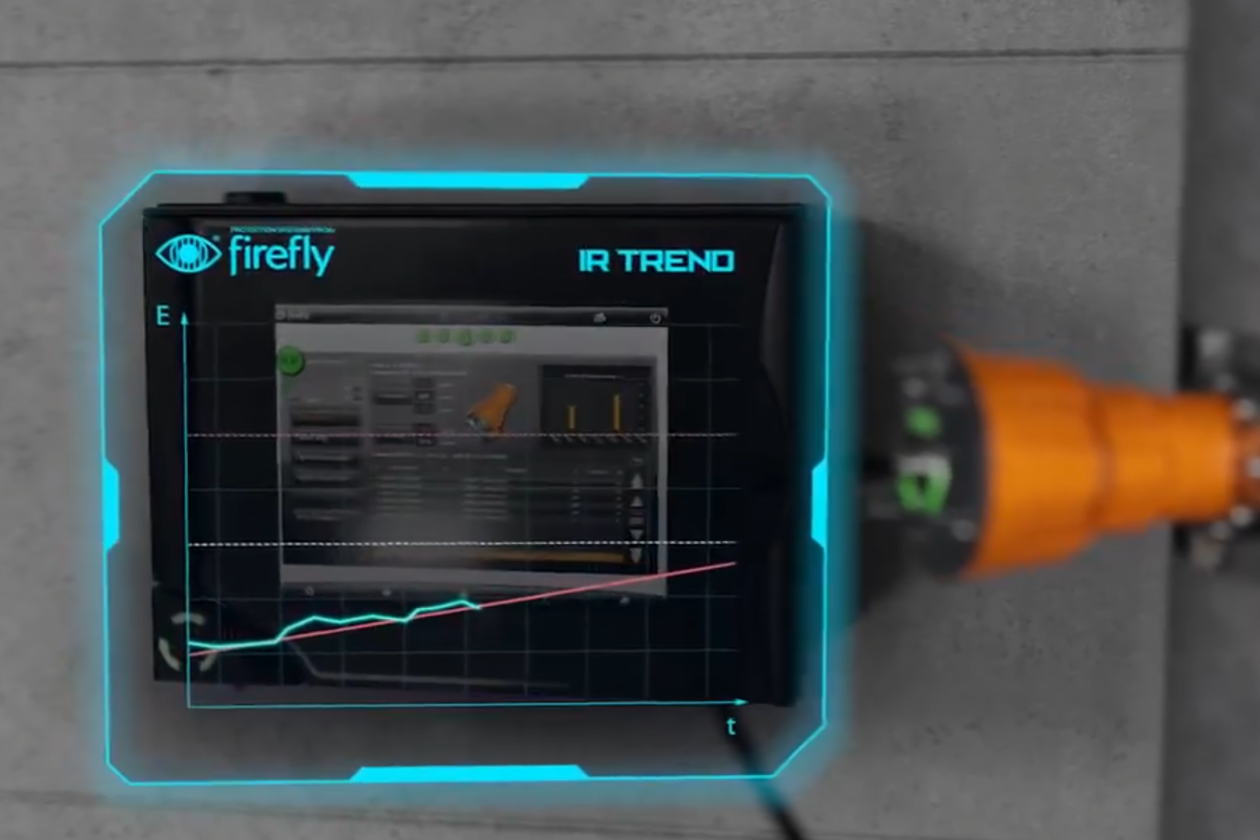
Firefly’s advanced hot particle detectors are designed to detect the radiated energy from hot particles in a material flow. By continuously monitoring this energy data and using AI-based algorithms, the system will be able to identify patterns, trends, and abnormalities in the process and provide operators with valuable information about the health of the process and the machinery.
This information can be further enhanced by integrating multiple sensors, combining data from additional sources such as continuous temperature measurements, vibration sensors, alignment sensors, and other condition-monitoring technologies to enable deeper analysis and higher predictive accuracy.